
From Impulse to Impact: Peter’s Energy, Redemption, and Purpose
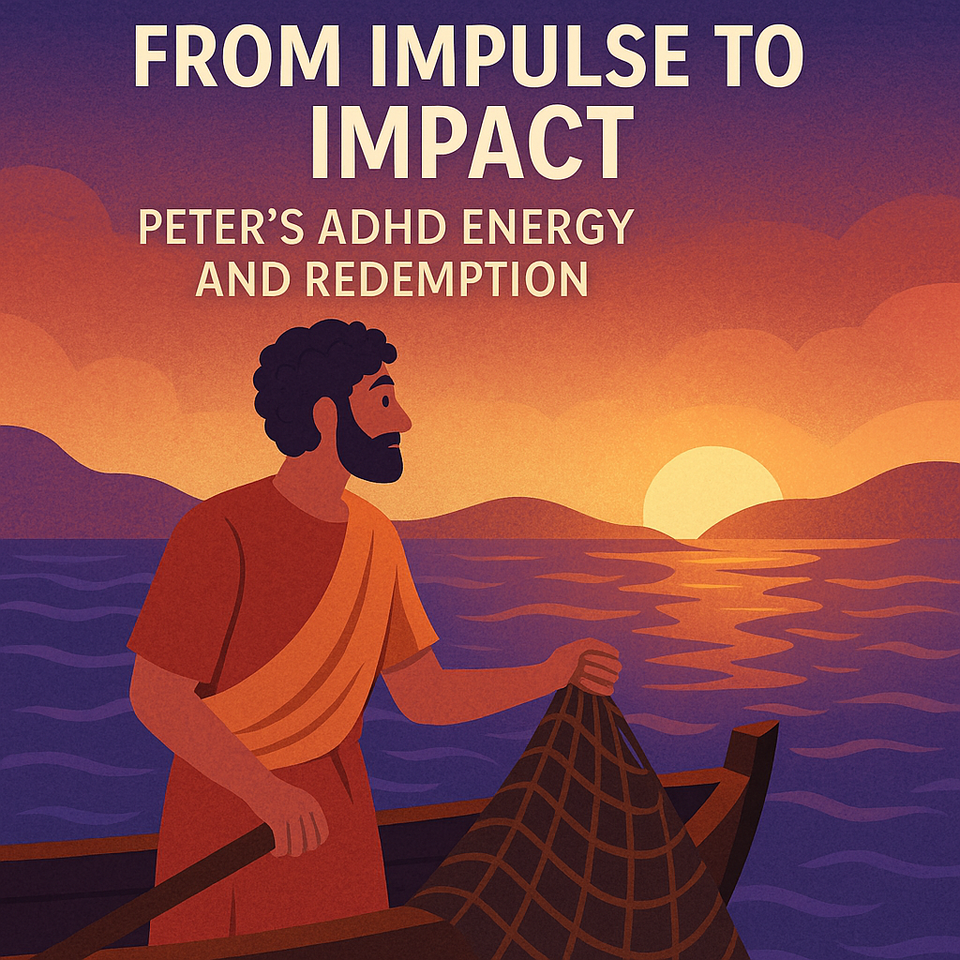
If anyone in Scripture makes my ADHD brain feel seen, it’s Peter.
He’s the one who jumps into the water before thinking about the waves.
The one who says, “I’ll never deny you”… and then does.
The one who reacts fast, feels deeply, and acts in the moment.
If Peter were in one of my coaching sessions, we’d probably be working on:
• Emotional regulation
• Impulsive decision-making
• Following through on commitments
• And yes—hyperfocus
But here’s what matters most:
Jesus didn’t dismiss Peter’s wiring.
He shaped it.
Impulsivity Isn’t Always the Enemy
Impulsivity can get us into trouble.
We act before thinking.
Speak before processing.
Commit before counting the cost.
That was Peter—over and over.
But when Jesus walked on water, Peter didn’t overanalyze.
He stepped out.
Yes, he sank.
But he also walked on water.
Impulsivity didn’t just lead to failure—it also led to an experience no one else in the boat had.
Sometimes the very thing that causes problems…
is also the thing that positions us for something more.
Emotional Intensity Needs Direction, Not Elimination
Peter felt everything deeply.
Bold declarations.
Crushing regret.
Protective reactions.
When he cut off the servant’s ear, it came from loyalty—but it was misdirected.
Later, that same emotional energy fueled his leadership and ministry.
The goal isn’t to become less emotional.
It’s to let emotion serve the right purpose.
Inconsistency Isn’t the End of the Story
Peter made big promises—and didn’t always follow through.
That courtyard moment?
That failure was real.
But Jesus didn’t define him by it.
He restored him.
“Feed my sheep.”
That wasn’t just forgiveness.
It was trust.
And from that point forward, Peter didn’t disappear.
He showed up.
Spoke boldly.
Led courageously.
Stayed anchored in purpose.
Hyperfocus Can Be Redirected
After Jesus’ death, Peter went back to fishing.
All night.
Focused. Engaged. Locked in.
That’s a picture many of us recognize.
But when Jesus called from the shore, Peter pivoted immediately.
He didn’t stay stuck in the task.
He moved toward the moment.
That’s the shift:
From task-focused…
to purpose-focused.
From Chaos to Calling
Peter didn’t lose his intensity.
He didn’t become passive or reserved.
He became aligned.
Impulsivity became responsiveness.
Emotion became passion.
Restlessness became readiness.
Hyperfocus became pursuit of purpose.
That’s the hope for us too.
Not removal of our wiring—
but redemption of it.
Practical Takeaways
- Bring your whole self to God
Don’t wait until you’ve “fixed” yourself. Start where you are. - Anchor your energy in purpose
Direction reduces chaos. - Build recovery into your rhythm
Emotional crashes need intentional reset. - Use focus strategically
When you’re locked in, ask: “Is this aligned with what matters?” - Don’t let failure define you
It didn’t define Peter—and it doesn’t define you.
A Moment with God
Lord, You created our minds with intention.
Help us to use our focus for what matters,
to lean on Your grace when emotions run high,
and to keep showing up—just like Peter did.
Align our hearts, our work, and our calling
so that our lives reflect You.
Amen.
Reflection
When has your intensity, impulsivity, or focus opened a door you wouldn’t have walked through otherwise?
What if that moment wasn’t a flaw—but a clue?
With grace and grit,
Gail



Comments ()