
“Just Stay Consistent” vs Real Life
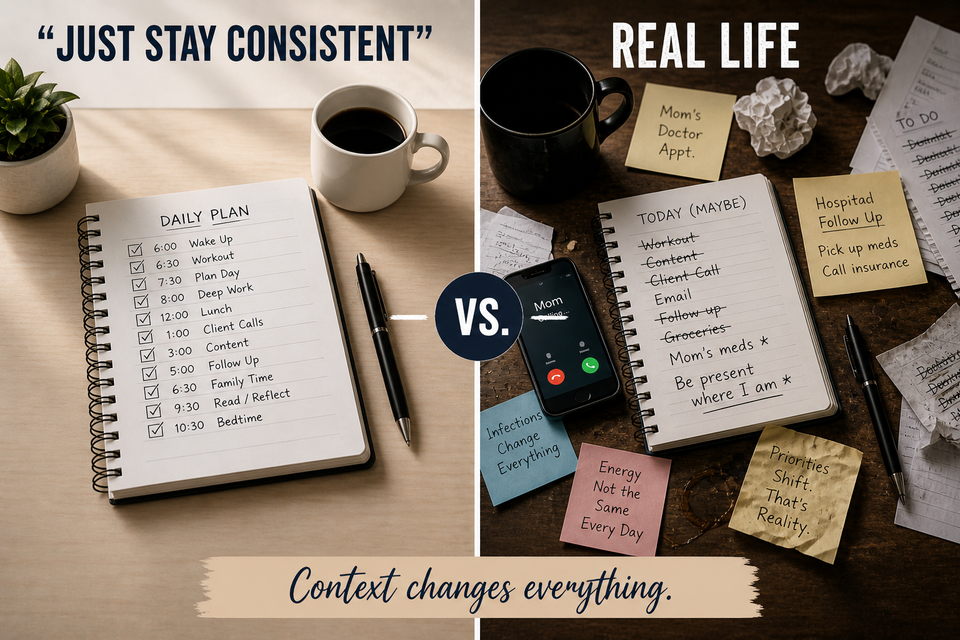
“Just stay consistent.”
You’ve heard it. Probably more than once this week.
It’s on gym walls. In your favorite business podcast. Threaded through every productivity app, planner, and “how I built my brand” reel you’ve scrolled past.
Consistency is key.
Show up every day.
Success isn’t motivation — it’s consistency.
If you’re not growing, you’re not consistent enough.
It sounds reasonable. It sounds true. In some seasons, it is.
So why does it feel like a quiet accusation for so many others?
In My Experience
I’ve sat in more than one room — virtual and otherwise — where someone stood up and told the story of a person who attended calls, ran their business, and hit significant numbers while a parent was in the hospital.
The message I took away was clear: that’s what consistency looks like.
That’s the standard.
I tried to follow it.
I failed.
And for a while, I thought that meant something was wrong with me.
Here’s what that story didn’t include — and what mine does.
My mother and I lived together for almost nineteen years. Not as caregiver and patient. As adults. Friends. We knew each other’s dreams, fears, strengths, and weaknesses. We laughed a lot. We built a real life together inside the same walls.
When her health started to decline, we made the choice to keep her home for as long as it was not dangerous for her to be at home. It wasn’t the easiest path. It wasn’t the most financially productive one. There were seasons of hospitals, infections, slow declines, and hard decisions — and through most of it, the practical support around us was thin.
When I focused on work, I felt guilty. When I stepped away from work to be present with her, I felt guilty about that too.
What I eventually found wasn’t perfect consistency. It was something harder to name and harder to post about: a balance between the work that mattered and the life that mattered more.
Some days that looked like progress.
Some days it looked like sitting with her and letting the to-do list wait.
She passed here at home. With me by her side. An honor I’m grateful for.
I have no regrets about how we spent that time.
I do have regrets about how long I measured myself against a story told in a room where mine would never have fit.
What the Advice Leaves Out
Consistency isn’t just about effort. It’s about what the conditions around that effort actually allow.
When life is relatively stable — predictable income, steady energy, no major disruptions, sufficient support — a level of consistency is likely achievable. It works. The person following it succeeds. Then they do what we all do: they distill it. They turn their experience into something shareable.
And the soundbite spreads.
What gets lost in that process is everything that made the conditions right in the first place. We also rarely hear from the people who followed the same advice and it didn’t work — because that story doesn’t travel as well.
We have a habit of finding a success, then reverse-engineering it into the simplest possible instruction. The instruction isn’t wrong. It’s just missing most of the story.
And here’s the other thing the soundbite leaves out: priority — and the reality that not everyone is working from the same set of circumstances, life experiences, or values.
I chose to prioritize time and focused attention on my mother over financial gain during that season. That was my decision, shaped by my life, my values, and what I knew I could live with. It was the right call — for me.
Someone else, in a different situation with different pressures, might make a different call. Both can be true. Neither requires justification.
The problem isn’t the priority someone chooses. The problem is advice that assumes everyone is working from the same set of circumstances, the same support structure, and the same definition of what success is supposed to look like.
The Way I Think About It Now
The goal isn’t perfect “consistency.” It’s sustainable progress — the kind that accounts for the full reality of your life, not just the version of it that performs well in a caption.
Some seasons you build.
Some seasons you hold.
Some seasons you tend to something that can’t wait.
All of it is real.
All of it counts.
Consistency matters. But it isn’t a fixed standard applied equally across every season of a life. It’s a practice that has to flex with the conditions you’re actually in — and with what those conditions are genuinely asking of you.
“Stay consistent” isn’t wrong advice. It’s incomplete advice.
And incomplete advice, handed to people in hard seasons, doesn’t inspire them.
It quietly convinces them the problem is them.
What If
Instead of:
Why am I not being consistent enough?
Try:
What are the actual conditions I’m working with right now?
What does sustainable look like in this season — honestly, not ideally?
What am I trying to stay consistent with, and does it still match what matters most?
That last one is worth sitting with.
Consistency in service of the wrong thing — or the right thing at the wrong time — isn’t discipline.
It’s just noise with a deadline.
Simple advice isn’t always wrong.
It’s just rarely the whole story.
And your life deserves more than a soundbite.
If this resonates, I’d be interested in how this has shown up in your life or work.

Comments ()