
Systems Create Freedom
Turning Chaos into Consistency
Let me say something that more than a few people will disagree with—the word system is not a dirty word.
I know, I know…for a lot of us—especially those of us who are creative, entrepreneurial, neuroextra, or just perpetually juggling seventeen things at once— “systems” sounds like a punishment. It conjures images of three-ring binders, flowcharts nobody uses, and corporate processes that exist mainly to slow everything down.
But that’s not what I’m talking about. I’m sure that really surprises you. What I’m talking about is actually something far, far simpler – and honestly far more freeing.
A System Is Just a More Consistent Way of Doing the Same Thing
Here’s the plain truth: you already have systems. You just don’t know it yet.
Every time you follow up with a prospect, you’re using a system—even if that system is “I try to remember and hope I don’t forget.” Every time you onboard a new client, prepare an invoice, schedule an appointment, or post to social media, you’re running a process of some kind.
The question isn’t whether you have systems. The question is whether yours are working for you or against you.
When there’s no consistent process, every recurring task becomes its own small decision. You have to think through it again. You have to remember the steps again. You essentially have to reinvent the wheel—again—when you’re already tired and already stretched thin. Think “death by a million paper cuts.”
And that mental overhead? It costs. Every. Single. Time. You. Do. It.
What Chaos Actually Costs You
Time is the obvious one. But the costs don’t just stop there. The costs don’t just stop at the office door.
It’s the mental energy you spend figuring out what to do next when you should already know. It’s the quality that slips when you’re winging it for the fourth time this week. It’s the dropped ball—the follow-up that didn’t happen, the client who didn’t feel welcomed, the invoice that went out late—because there was no reliable process to catch it.
If those business problems weren’t enough. It costs more than that. And it's not just your business that pays the price. Frayed nerves, lost sleep, a short fuse at the dinner table — chaos doesn't stay in your inbox.
Chaos doesn’t just slow you down. It wears you out. And when you’re worn out, you’re not leading well. You’re reacting. You’re putting out fires instead of building something.
But Let’s Be Honest About What a System Actually Is
Before you check out, let me pump the brakes for a second—because there’s a version of “just build a system” advice that absolutely sets you up to fail. And fail hard. Something that can turn you off all future system improvements.
Now, a system is not an inherently better way of doing something. But it is a more consistent way of doing something. My friend Suzie teaches music. She tells her students that “Practice doesn’t make perfect. Practice makes permanent. Perfect practice makes perfect.” The concept is true with systems.
That distinction matters. You can build a flawlessly efficient system that produces terrible results. If you have a system for burning toast, congratulations—you will get perfectly burnt toast every single morning without fail.
So why bother? Because consistency is a prerequisite for making something sustainably better. If you’re curious why that’s true, here’s what’s happening behind the scenes (for my bottom-line people who have hung with me past the title, please feel free to skip to the bottom):
You can’t improve what you can’t predict. If you do a task differently every time and get a bad result, you don’t actually know what went wrong. Was it the timing? The tools? Your mood? A system isolates the variables. When you follow the same steps and still get a bad result, now you know exactly where to troubleshoot. Identify the most potential problem area, tweak that one step, measure the outcome, and optimize. Repeat as needed and no more. Without the system, you’re just guessing.
It decouples results from the person. Without a system, success depends on talent, mood, energy, or luck. With a system, success depends on the steps. That means you can hand the process to someone entirely new, and as long as they follow it, they will get the same result the expert got. Just like 1+1=2 whether done by a Harvard graduate with a degree in mathematics or a first grader. That’s not just efficiency, that’s scalable quality.
It eliminates decision fatigue. This is the hidden superpower many people miss (or they just think they don’t have time). When you don’t have a system, your brain burns energy every time deciding how to do the task before you even start doing it. A system offloads that cognitive weight entirely. You don’t have to think—you just execute. And what can you do with that saved mental energy? Redirect it toward higher-level work that needs your full attention.
It creates a baseline. Think of a system like a save point in a video game. Once a process is systematized, quality can’t drop below that line. You’re no longer defending ground you’ve already covered. You’re only building upward.
The bottom line:
A system doesn’t guarantee excellence right out of the gate. It creates the stable foundation—the consistency, the predictability, the measurability—that makes excellence possible.
Where to Start (Without Overwhelming Yourself)
You don’t have to build Rome in a day. In fact, please don’t try. I’ve watched too many people get excited about systematizing everything, build out a beautifully complex process library, and then abandon the whole thing because it became a project of its own. Truth is, I’ve been guilty of this myself. This is where it is critical to fight scope creep.
Start with one thing. Let me say that again so we all hear it. Start. With. One. Thing.
Think about the tasks in your business or personal life that feel repetitive or frustrating. The ones where you catch yourself thinking, Didn’t I just do this? Why does this feel harder than it should?
Pick one. Just one.
Then do this:
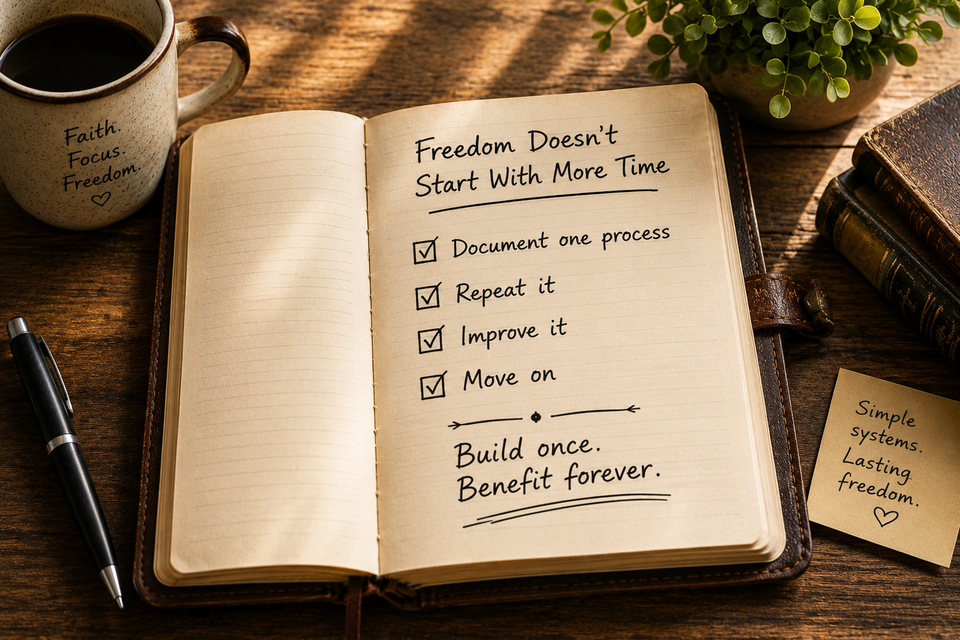
1. Write down the steps as you actually do them—not how you think you should do them. Capture what’s real.
2. Turn it into a simple checklist or template you can reuse. This doesn’t have to be fancy. A document, a note in your phone, a shared file, a whiteboard—whatever you’ll actually use.
3. Test it once. Run through it on purpose the next time that task comes up and see if anything’s missing.
4. Refine it once or twice based on what you learn, then leave it alone.
That’s it. That’s the whole process. One task. Written down. Made repeatable. Done.
Small Consistent Improvements Win
I’m a systems thinker by nature and by training—years in technology, federal leadership, coaching, and building businesses. And here’s what I’ve learned from all of it: the biggest long-term results rarely come from the dramatic overhaul. They come from small improvements made consistently over time.
Document one process this month. Another one next month. By the end of the year. You’ve built something that runs smoother, scales better, and gives you back hours you didn’t know you were losing. Who knows, you may even be able to join your kids on that vacation.
That’s not just good business strategy. That’s stewardship.
Your Next Step
This week, pick one recurring task that feels repetitive or frustrating. Write down how you do it. Turn it into something you can hand off, repeat, or reference next time it comes up.
It doesn't have to be perfect. It just has to be written down and followed.
Your future self—and your business—will thank you.



Comments ()