
Your Business Exists to Solve Problems, Not Admire Solutions
I heard a statement recently that's been rattling around in my head: "Fall more in love with your client's problem than with your own solution."
The more I sat with it, the more I found myself uncomfortable with wanting to be in love with a problem. I started thinking of it a little differently.
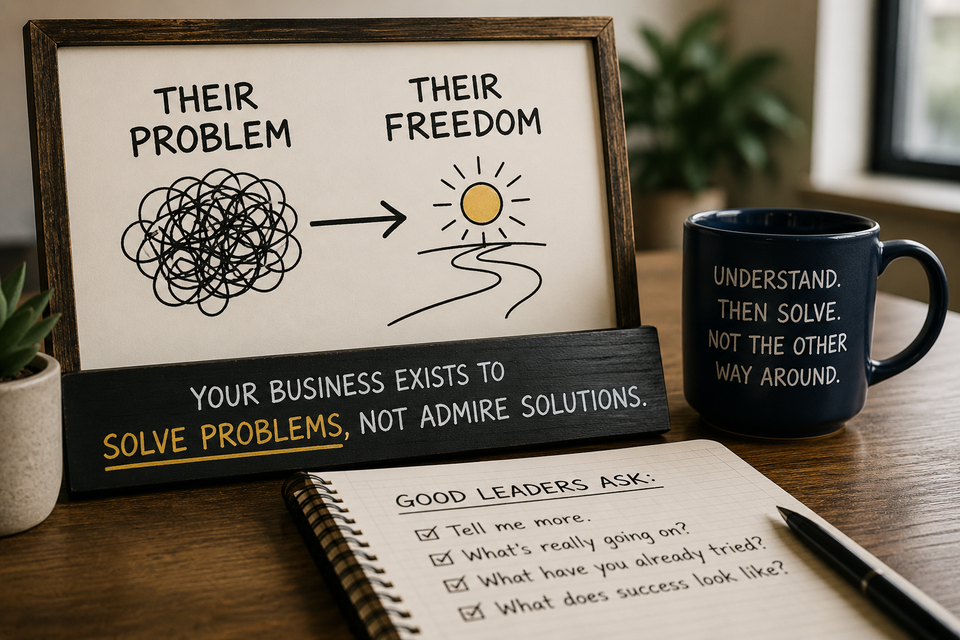
A business should exist to solve problems, not admire solutions.
That might sound obvious. It's also one of the easiest traps to fall into – as business owners, coaches, consultants, counselors, mentors, developers, leaders. I've watched many people fall into it. I've caught myself there more than once.
When we've invested weeks, months, or years building something we are proud of, something we know can help others, it's natural to want to talk about it. We remember the late nights, the revisions, the incremental improvements, the lessons learned, the excitement of finally putting it into the world.
Before long, something subtle happens. We stop thinking about solving our client's problem and start thinking about presenting our solution. The conversation quietly shits – from understanding the person across the table to explaining what we built.
Without realizing it, we've gone from serving the client to showcasing the solution.
Let's Be Honest
This isn't a marketing issue. It's a leadership issue.
A leader's first responsibility is to understand before trying to solve.
That's true whether we're leading a business, a nonprofit, a ministry, a team, or just sitting across the table helping a friend. People don't need someone anxious to hand out answers. We need someone who genuinely want to understand.
I learned this years ago: good design always starts with understanding. Software, a business, a service, a process, a solution – even a math problem – the fastest way to build the wrong thing is to skip understanding the right one.
When we fall into that trap, it shows up in small ways:
- We ask fewer questions
- We listen just long enough to recognize a familiar pattern
- Instead of staying curious, we get confident we've already diagnosed it
- We start explaining before we've fully understood – definitely before the client is confident we understand
When Every Customer Looks Like a Nail
There's an old saying about hammers and nails. My twist on it: don't get so proud of your hammer that every customer starts looking like a nail.
Every business builds its own hammers:
- Software companies build software
- Financial advisors build financial plans
- Counselors develop techniques
- Coaches develop frameworks
- Consultants create methodologies
There's nothing wrong with that. Reusable solutions are often born because we've helped enough people with similar problems to spot the pattern. Creating something that consistently helps people is a good thing.
The problem comes when we start believing our hammer is the answer to every situation. Sometimes it is the solution. Sometimes it isn't. Wisdom is knowing the difference.
The Client's Freedom Is the Goal
In my business, the solution I create isn't the product – the client's freedom is. Whatever they are trying to accomplish, that's the destination. My coaching, my business design work, my AI solutions, my writing – all of it is just a set of tools that might help them get there.
Sometimes my products are exactly what someone needs. Sometimes they only need part of what I offer. Sometimes they need something completely different. Some of the most satisfying conversations I've ever had ended without anyone becoming a client – because the best way I could serve them was pointing them toward another coach, another product, another solution that fit better than mine.
Helping someone find the right solution matters more than helping them choose mine.
One Question That Changes Everything
What problem can I honestly help this person solve?
That one question changes everything:
- It changes how I listen
- It changes the questions I ask
- It changes whether I recommend one of my solutions, adapt it, or point someone in an entirely different direction
It reminds me my job isn't to prove the value of what I built. My job is to honestly determine whether what I have to offer is the right fit – for them, not for my bottom line.
The Kind of Business I Want to Build
My business doesn't exist to admire the solutions I've created. It exists to help people solve problems.
If one of my solutions helps accomplish that, wonderful! If someone else's does, that's wonderful too. At the end of the day, I don't want to build a business known for its products.
I want to build a business known for helping others.



Comments ()