Stop Working Like Everyone Else (And Start Working Like You)
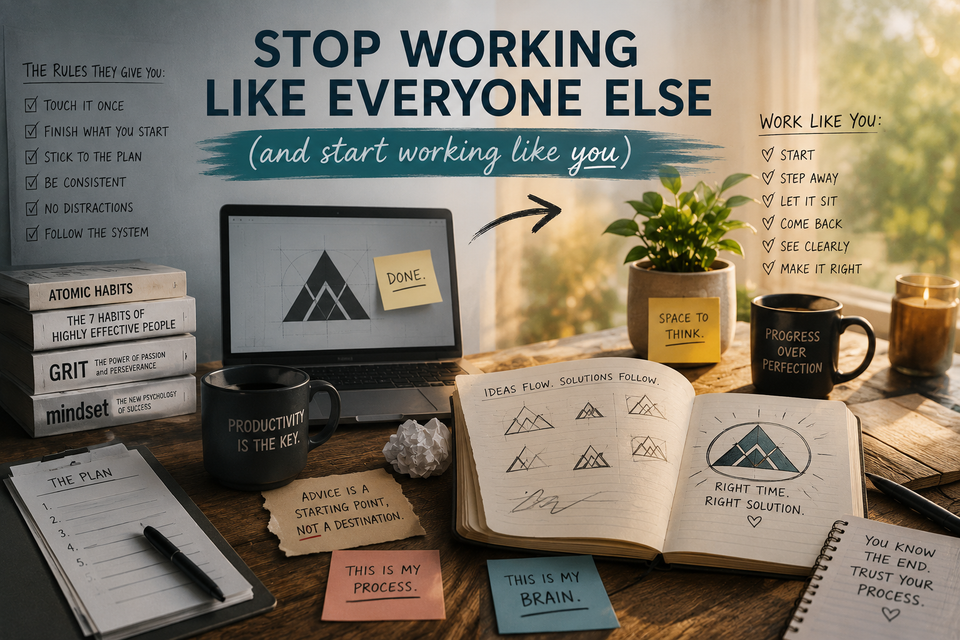
The books are not wrong. Let me say that up front.
"Atomic Habits." "The 7 Habits of Highly Effective People." "Grit." "Mindset." These are good books. Smart people wrote them. The research behind them is real.
And I've also tried to follow their advice — sometimes with results bad enough to make me want to crawl under a table.
Here's what nobody puts on the back cover: advice that works for someone else is a starting point, not a destination.
The Logo That Told on Me
The advice arrived inside a glossy productivity book, delivered with the absolute certainty of a mathematical proof: Touch it once. Finish what you start. Do not put a task down until it is done.
It sounded clean. It sounded efficient. It sounded like the exact cure for my neuroextra brain.
So when I sat down to design a logo for one of my initiatives, I resolved to follow the rules. I set a timer, fired up the software, pushed the shapes around until they fit the new brand. I worked my way through it in one continuous session and finished with 2 minutes to spare. It "worked." I checked the box, touched it once, saved the file, and congratulated myself on finally working like a true professional.
Three weeks later, I opened the file again and my stomach dropped.
It wasn't just flawed. It was completely wrong. The soul was missing. The proportions felt dead, the vibe entirely off. By forcing the design into a single, linear heat-cycle, I had followed the process perfectly and completely missed the point.
That was the day I threw out the rigid rules and the "touch it once" mantra.
Instead, I learned to stop when the work shifted from creating to simply trying to finish. That was usually the sign that I needed distance, not more effort.
So I started stepping away on purpose. Letting my subconscious keep working on the problem while I moved on to other things. Sometimes an idea would hit while driving. Occasionally while folding laundry, because...folding laundry. Sometimes weeks later after enough distance existed for me to actually see the thing again.
When I finally reopened that logo, I changed almost everything about it — the feel, the flow, the energy behind it...kept the name. The final version looked nothing like the first one.
And it was right.
The irony is that I probably never would have reached the right logo without creating the wrong one first.
For a neuroextra brain, creativity isn't an assembly line. It's cycles. Intensity, pause, return, clarity.
The book wasn't wrong about efficiency. But it didn't know my brain.
The Sleep Experiment Nobody Warned Me About
My bedroom felt less like a sanctuary and more like a laboratory where I had repeatedly failed the experiment of falling asleep.
I followed the standard sleep hygiene gospel to the letter. No screens for two hours before bed. Blackout curtains drawn tight. White noise machine humming a sterile frequency. I laid there, perfectly positioned, staring at the absolute blackness of the back of my eyelids.
And my brain went to war.
In the forced silence, my mind didn't wind down — it accelerated. It filled the void with everything I hadn't finished, every conversation from three years ago, every area of life I was failing at, and an agonizingly loud countdown of how few hours of sleep I had left. I was exhausting myself trying to perform sleep.
The breaking point came the night I just couldn't keep doing it another night. Desperate, I broke every rule in the book. I grabbed my phone, pulled up YouTube, and put on a broadcast of an old baseball game. I knew the outcome. No suspense, no flashing alerts — just the rhythmic, familiar murmur of the stadium crowd and low-stakes commentary.
Within four minutes, my eyelids grew heavy.
The background noise of the ballpark gave my racing mind a harmless, predictable track to coast on, crowding out the anxiety loop. I fell asleep with the screen glowing beside me. I woke refreshed.
I learned my brain doesn't calm down in silence. It needs something steady to settle against. Now I guard my unpredictable sleep windows fiercely, knowing that sometimes an old movie is the only key that can quiet the internal engine enough to finally rest.
The sleep experts weren't wrong either. Their research is real. But it wasn't written for my nervous system.
The Part the Books Don't Include
Stephen Covey said to begin with the end in mind. That principle has never failed me — not once. But how I get to that end? That part I had to figure out for myself.
Most great books give you a framework built from someone else's brain, someone else's research, someone else's nervous system. The framework is usually solid. The translation is always yours to do.
That's not a flaw in the books. That's just the nature of advice.
Advice is a starting point. Your life is the lab.
What This Actually Looks Like
When we encounter a framework, a method, a habit system, a morning routine — here's the real work:
Keep what fits. If it resonates and it moves us forward, use it without apology.
Release what doesn't. Not every strategy was designed for our brain, our season, our nervous system, or our life. Letting it go is not failure. It's discernment.
Modify what's almost there. This is where the real magic lives. Don't throw the baby out with the bath. Take the core principle, strip the rigid prescription, and rebuild it in a shape that actually fits our lives.
The goal was never to work like the author. The goal was always to work like ourselves — more intentionally, more effectively, more sustainably, and shaped around how our minds work.
We are not broken because someone else's system didn't work for us.
We are not lazy because we couldn't make ourselves fit inside someone else's framework.
We are human. And the best work we will ever do will be the work we've shaped around how our minds were built.
The books gave us raw material. What we build with it is entirely up to us.
Take what's useful.
Adapt what isn't.
Leave the rest behind.
We don't need to work like everyone else.
We need to learn how to work with the way our own minds were built.


Comments ()