The Truth About Decision-Making (That Memes Get Wrong)
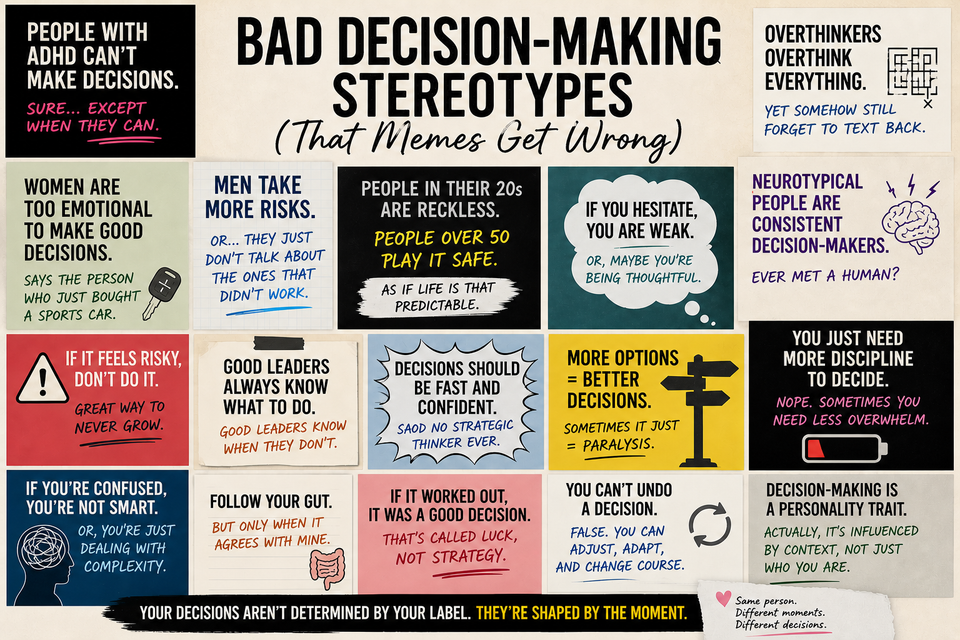
We’ve all seen them.
“People with ADHD can’t make decisions.”
“Analytical personalities overthink everything.”
“Women are emotional decision-makers.”
“Men take more risks.”
“People in their 20s are reckless.”
“People over 50 play it safe.”
They’re catchy. They’re simple.
And they’re mostly incomplete.
Here’s the reality I’ve seen—both in research and in real life:
Decision-making isn’t owned by a group. It’s shaped by conditions.
What I’ve Actually Observed
I’ve watched highly analytical people make fast, decisive calls when the stakes were clear.
I’ve watched spontaneous, creative thinkers stall completely when there were too many options.
I’ve seen people with neuroextra minds (think ADHD-like) make bold, decisive calls under pressure—and I’ve seen those same people struggle to act in situations where the urgency or value of deciding isn’t clear.
I’ve seen seasoned professionals make poor decisions.
I’ve seen people with very little experience make excellent decisions.
And I’ve seen those same people, in different moments, approach decisions in completely different ways—sometimes moving quickly and clearly, other times hesitating, delaying, or shifting direction entirely.
Same people. Different moments. Very different decision-making.
The Real Drivers Behind Decisions
Research I’ve seen indicates decision-making tends to shift based on things like:
- Clarity vs. ambiguity
- Time pressure, real or perceived
- Energy and mental load
- Risk tolerance
- Past experiences
- Confidence vs. competence
- Environment and support
- Emotional state
- Feedback from previous decisions
None of those are exclusive to a specific “type” of person.
What About ADHD, Personality, or Age?
Do they matter? Yes.
Do they determine decision quality? No.
They influence how someone processes information, not whether they are capable of making strong decisions.
For example:
- A neuroextra brain may respond more strongly to urgency, novelty, interest, or delayed reward.
- An analytical thinker may process more variables before acting.
- Experience may shape pattern recognition.
- Age, education, and career stage may influence confidence, caution, speed, or risk tolerance.
But none of these guarantee a specific result.
They shift how a person tends to process and approach decisions—not whether the decision itself will be effective or lead to a specific outcome.
Knowing how you tend to make decisions doesn’t limit you—it gives you leverage.
Research in areas like metacognition and behavioral decision-making shows that when people recognize their own patterns, they can adjust how they approach decisions.
That might look like:
- slowing down when you tend to rush
- creating structure when you tend to delay
- seeking input when you tend to decide in isolation
Awareness doesn’t remove tendencies—but it gives you a way to work with them instead of being driven by them.
What Happens After a “Good” or “Bad” Decision?
This part matters more than most people realize.
What someone believes about their last decision often affects the next one.
If a decision is perceived as “good,” people may move faster, feel more confident, or take on more risk.
If a decision is perceived as “bad,” people may hesitate, second-guess, avoid deciding, or overcorrect.
That perception may come from:
- The outcome the decision produced
- Feedback from others
- Internal standards or expectations
The catch is this:
The perception isn’t always accurate.
A well-reasoned decision can still lead to a poor outcome.
A weak decision can still appear successful.
So what carries forward isn’t just the result—it’s the interpretation of the result.
And that interpretation can shape the next decision, whether the topic is similar or completely different.
Decision Quality vs. Decision Outcome
Not all outcomes reflect the quality of the decision that led to them.
A decision can be:
- Thought through
- Based on the information available at the time
- Aligned with values and purpose
…and still lead to a poor outcome.
And the opposite is also true.
A decision can be:
- Rushed
- Based on assumptions
- Misaligned or incomplete
…and still appear successful.
Outcomes are influenced by things like:
- Timing
- Execution, yours or someone else’s
- Missing or changing information
- Other people’s actions
- Unpredictable events
So what “worked” or “didn’t work” isn’t always a clear indicator of whether the decision itself was strong.
Why the Memes Miss the Mark
Memes simplify complex behavior into categories because it’s easy to share and easy to relate to.
They’re also easy to manipulate into supporting almost any point—regardless of accuracy.
That combination makes them powerful—and unreliable.
They can quietly reinforce ideas like:
“I’m just wired this way.”
“I can’t help it.”
“This is how people like me make decisions.”
But real-world behavior doesn’t stay inside those lines.
A Better Way to Think About Decisions
Instead of asking:
“Was that a good decision?”
A more useful question is:
- What information did I have at the time?
- What assumptions did I make?
- Did I allow bias, blind spots, or incomplete perspective to influence the decision?
- Was I reacting—or responding?
- Did this align with my values, goals, and responsibility level?
- What did I learn from the process?
That’s where growth actually happens.
The Bottom Line
A “good” decision isn’t defined only by whether things worked out.
It’s defined by whether the decision:
- Used the best information available at the time
- Considered relevant risks and trade-offs
- Aligned with values, purpose, and responsibility
- Was made intentionally—not purely reactively
Outcomes still matter—but they don’t tell the whole story.
Decision-making isn’t determined by the group you belong to.
It’s influenced by how you process the situation you’re in—and how you interpret what happened after.
We’re all capable of making strong decisions.
We’re also all capable of hesitation, misjudgment, or delay.
The goal isn’t to fit a category.
It’s to become more aware of:
- what’s influencing the decision in front of you
- what patterns you tend to follow
- and what you’re carrying forward into the next decision

Comments ()